Introduction
For hotels, guesthouses, boutique properties, resorts, apartments, and vacation rentals, online visibility has become the foundation of business success. Travelers rarely walk into a hotel without researching it online first. Most reservations now begin with a search engine, a travel platform, social media, or a direct recommendation supported by digital content.
Among all online travel agencies (OTAs), Booking.com remains one of the most influential platforms in the hospitality industry. Millions of travelers use it every day to compare prices, discover accommodations, read reviews, and make instant reservations. For many hotel owners, Booking.com is often the first major source of bookings.
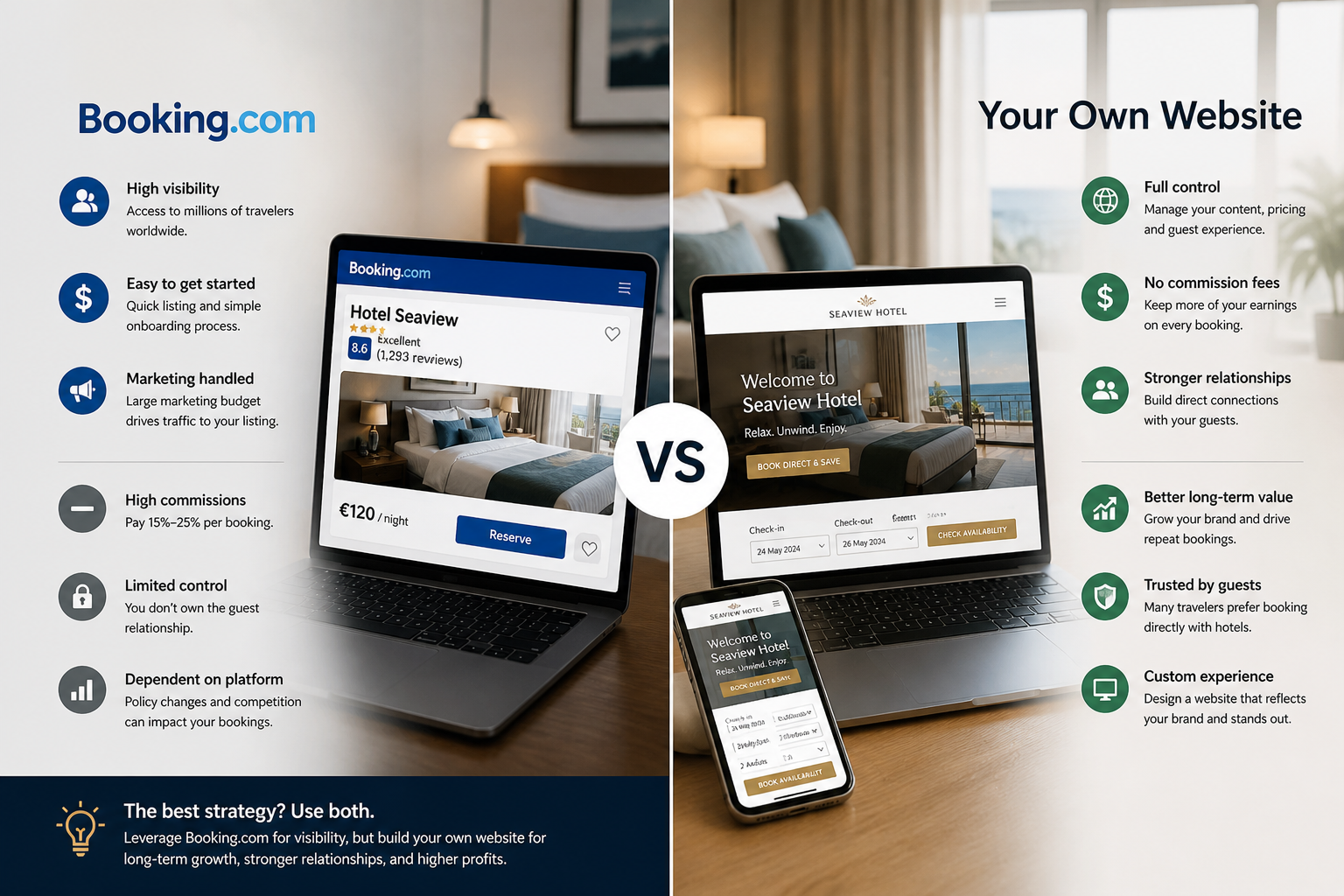
At the same time, relying entirely on Booking.com can create long-term challenges. Commission fees reduce margins, customer relationships remain controlled by the platform, and direct brand loyalty becomes harder to build.
This creates an important question for accommodation owners:
Should you focus on Booking.com or invest in your own website?
The answer is not simply one or the other. Understanding the strengths and limitations of both channels is essential for building a profitable, sustainable hospitality business.
This article explores the advantages, disadvantages, financial implications, marketing strategies, branding opportunities, and long-term business impact of Booking.com versus your own direct booking website.
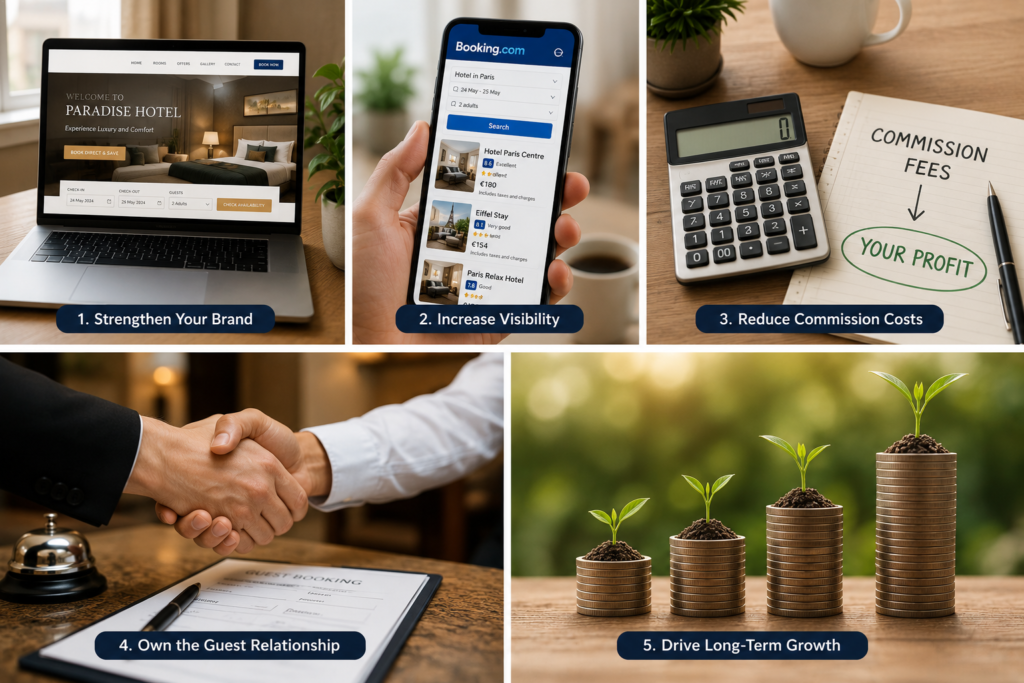
Understanding Booking.com
Booking.com is one of the world’s largest online travel agencies. Founded in the Netherlands in 1996, the platform now operates globally and lists millions of accommodations.
For hotel owners, Booking.com offers instant exposure to a massive audience. Travelers trust the platform, making it easier for smaller or lesser-known properties to receive reservations.
Booking.com provides:
- International visibility
- Secure payment systems
- Multi-language support
- Guest review management
- Reservation systems
- Mobile booking optimization
- Marketing campaigns and promotions
- Customer service infrastructure
For many small hotels, Booking.com acts as a ready-made sales engine.
The Main Advantages of Booking.com
1. Immediate Visibility
One of the biggest challenges for independent hotels is attracting traffic online. Creating a website alone does not guarantee visitors.
Booking.com already has enormous global traffic. Travelers searching for accommodations in almost any destination will likely use the platform.
This means even a new property can quickly gain visibility without investing heavily in advertising.
For example:
- A new boutique hotel in Laos
- A guesthouse in Colombia
- A small resort in Thailand
- A family-run hotel in Portugal
can all receive international bookings almost immediately after joining the platform.
2. Trust and Credibility
Travelers often trust Booking.com because of:
- Verified reviews
- Secure payments
- Clear cancellation policies
- Strong customer support
- Familiar booking experience
A small independent hotel website may appear less trustworthy to first-time visitors.
Booking.com reduces traveler hesitation.
3. Easy Setup
Launching a property on Booking.com is relatively simple.
The platform provides tools for:
- Managing room inventory
- Uploading photos
- Adjusting rates
- Synchronizing calendars
- Handling promotions
- Tracking analytics
Many small hotels start receiving bookings within days.
4. Mobile Reach
A significant percentage of travelers now book through smartphones.
Booking.com has heavily optimized its mobile experience, allowing hotels to benefit from:
- Fast mobile reservations
- International app users
- Mobile-only promotions
- Last-minute booking visibility
Building a high-performance mobile website independently requires additional investment.
5. International Marketing Power
Booking.com spends billions on global advertising campaigns, search engine optimization, and digital marketing.
Hotels listed on the platform indirectly benefit from this enormous marketing ecosystem.
Without Booking.com, independent properties would need substantial marketing budgets to reach similar audiences.
The Main Disadvantages of Booking.com
1. Commission Fees
The biggest criticism of Booking.com is commission.
Depending on location and agreement, hotels often pay between 10% and 25% per reservation.
Over time, this becomes extremely expensive.
For example:
- A room sold for $100
- 20% commission
- Hotel receives only $80
Now multiply this by hundreds or thousands of reservations annually.
The impact on profitability becomes significant.
2. Limited Customer Ownership
When guests book through Booking.com, the platform controls much of the customer relationship.
Hotels may have limited access to:
- Direct customer communication
- Marketing permissions
- Guest data
- Retargeting opportunities
This makes it harder to build long-term loyalty.
Guests often remember Booking.com more than the hotel itself.
3. Strong Competition
On Booking.com, your property appears next to competitors.
Travelers compare:
- Prices
- Ratings
- Amenities
- Photos
- Locations
- Cancellation policies
This creates constant pricing pressure.
Hotels may reduce prices simply to remain competitive in search rankings.
4. Dependence on the Platform
Some hotels become overly dependent on Booking.com.
If the platform changes:
- Algorithms
- Policies
- Commission structures
- Visibility rankings
the hotel’s revenue may suffer immediately.
Heavy dependency creates business vulnerability.
5. Brand Identity Challenges
Booking.com standardizes much of the booking experience.
While hotels can upload photos and descriptions, the overall customer journey remains inside the Booking.com ecosystem.
This limits the ability to create:
- Unique storytelling
- Emotional branding
- Distinctive customer experiences
- Personalized marketing journeys
The Power of Your Own Website
A direct booking website gives hotels complete control over branding, customer relationships, and revenue.
Instead of depending entirely on OTAs, hotels can build their own long-term digital assets.
A website acts as:
- A booking platform
- A marketing channel
- A branding tool
- A customer relationship hub
- A content platform
- A direct communication system
Advantages of Your Own Hotel Website
1. Higher Profit Margins
Direct bookings avoid OTA commissions.
Even after accounting for:
- Website hosting
- Payment processing fees
- Marketing costs
- SEO investment
many hotels still retain more profit per reservation.
For example:
- Booking.com reservation: 20% commission
- Direct website booking: 3% payment processing fee
The financial difference becomes substantial over time.
2. Full Brand Control
Your website represents your hotel exactly as you want.
You control:
- Design
- Colors
- Photography
- Tone of voice
- Storytelling
- Guest experience
- Promotions
- Content strategy
This allows stronger emotional branding.
A luxury boutique hotel can create an entirely different atmosphere than a budget hostel.
3. Better Customer Relationships
Direct bookings create stronger guest connections.
Hotels can:
- Build email lists
- Send newsletters
- Offer loyalty rewards
- Create personalized offers
- Encourage repeat stays
- Upsell services
Long-term customer relationships increase profitability.
4. SEO and Organic Traffic
A strong website can attract travelers directly through Google searches.
Examples:
- “Best boutique hotel in Luang Prabang”
- “Romantic hotel in Lisbon”
- “Eco resort in Colombia”
Through search engine optimization (SEO), hotels can generate free long-term traffic.
Unlike paid OTA commissions, SEO becomes a long-term digital investment.
5. Greater Flexibility
Your own website allows unlimited flexibility.
Hotels can:
- Create packages
- Sell tours
- Offer restaurant reservations
- Promote spa services
- Add blogs
- Build destination guides
- Create memberships
- Sell gift cards
This transforms the website into a complete business ecosystem.
The Challenges of Running Your Own Website
1. Marketing Requires Time and Money
A website without traffic produces no reservations.
Hotels must invest in:
- SEO
- Google Ads
- Social media
- Content marketing
- Photography
- Branding
- Email marketing
Building visibility takes time.
2. Technical Maintenance
Websites require:
- Security updates
- Booking engine maintenance
- Mobile optimization
- Speed optimization
- Backup systems
- Payment integration
Poor technical performance can reduce conversions.
3. Trust Building Takes Time
Travelers may hesitate to book directly with unknown hotels.
Your website must establish credibility through:
- Professional design
- Reviews
- High-quality photos
- Secure payment systems
- Transparent policies
- Active social media presence
Trust is essential for conversion.
4. Competition with Major Platforms
Competing directly against Booking.com’s advertising power is difficult.
OTAs dominate Google search results for many hotel-related keywords.
Independent hotels must find creative strategies to attract direct traffic.
Financial Comparison: OTA vs Direct Booking
Let’s compare a simplified scenario.
Scenario
A hotel sells 1,000 room nights annually.
Average room price: $120
Through Booking.com
- Revenue: $120,000
- 18% commission: $21,600
- Net revenue: $98,400
Through Direct Website
- Revenue: $120,000
- Payment fees + marketing + maintenance: $8,000–$15,000
- Net revenue: potentially higher
Direct bookings often provide stronger long-term profitability.
However, reaching that stage requires marketing investment.
Why Smart Hotels Use Both
The most successful hospitality businesses usually combine both strategies.
Booking.com provides:
- Visibility
- Discovery
- International exposure
- Immediate reservations
Your website provides:
- Higher margins
- Brand identity
- Customer loyalty
- Long-term business value
Rather than choosing one exclusively, smart hotels use Booking.com strategically while encouraging repeat direct bookings.
How Hotels Convert OTA Guests into Direct Customers
Many hotels use Booking.com as a customer acquisition channel.
After the first stay, they encourage guests to book directly next time.
Strategies include:
Personalized Service
Guests remember excellent experiences.
Strong hospitality encourages repeat visits.
Email Collection
Hotels can invite guests to subscribe to newsletters or promotions.
This creates direct marketing opportunities.
Loyalty Discounts
Offer returning guests:
- Better rates
- Free breakfast
- Late check-out
- Room upgrades
Direct booking benefits encourage future reservations.
QR Codes and Printed Materials
Hotels can promote their website inside rooms, restaurants, or reception areas.
Simple messaging works well:
“Book directly next time for exclusive benefits.”
Social Media Community Building
Instagram, Facebook, TikTok, and YouTube help hotels create direct relationships with travelers.
A strong social presence reduces OTA dependence.
The Role of SEO in Direct Bookings
Search engine optimization is one of the most powerful long-term investments for hotel websites.
Good SEO allows hotels to rank on Google for valuable searches.
Important SEO elements include:
- Fast website speed
- Mobile optimization
- High-quality content
- Local guides
- Blog articles
- Keyword optimization
- Technical SEO
- Quality backlinks
Hotels that consistently publish useful content can attract travelers organically.
The Importance of Photography
Photography strongly influences booking decisions.
Whether on Booking.com or your own website, visual presentation matters enormously.
Professional images should include:
- Rooms
- Bathrooms
- Restaurant areas
- Views
- Pool
- Reception
- Local surroundings
- Guest experiences
Great photography increases conversion rates.
Why Branding Matters More Than Ever
Modern travelers increasingly seek experiences, not just rooms.
Brand identity helps hotels differentiate themselves.
Examples of strong branding:
- Eco-friendly retreats
- Wellness resorts
- Digital nomad hotels
- Luxury boutique experiences
- Cultural immersion stays
- Minimalist urban hotels
Your own website allows deeper storytelling than OTA listings.
The Future of Hotel Distribution
The hospitality industry continues evolving rapidly.
Several trends are shaping the future:
AI-Powered Travel Planning
Artificial intelligence increasingly influences how travelers discover hotels.
Hotels with strong digital content and direct branding may gain long-term advantages.
Increased Direct Booking Strategies
Many hotels now prioritize direct reservations to reduce commission costs.
This trend continues growing.
Experience-Based Marketing
Travelers want:
- Authenticity
- Local culture
- Personalized stays
- Memorable experiences
Websites help communicate these experiences more effectively.
Multi-Channel Distribution
Successful hotels rarely depend on a single source.
Future success will likely come from balanced distribution across:
- OTAs
- Direct websites
- Social media
- Google Hotel Ads
- Metasearch platforms
- Email marketing
Which Strategy Is Best?
The ideal strategy depends on your business stage.
New Hotels
New properties often benefit significantly from Booking.com because:
- Visibility is immediate
- Trust already exists
- Marketing barriers are lower
Established Hotels
Hotels with strong reputations should invest heavily in direct bookings.
This improves:
- Profit margins
- Customer retention
- Brand value
- Long-term independence
Boutique and Luxury Hotels
Brand storytelling becomes extremely important.
A strong direct website can become a powerful competitive advantage.
Budget Hotels
OTAs may remain highly important due to price-based customer behavior.
However, direct loyalty programs still help increase repeat business.
Final Thoughts
Booking.com is an extremely powerful platform that can generate significant business for hotels worldwide. For many properties, especially new or smaller accommodations, it provides essential visibility and consistent reservations.
However, relying entirely on OTAs creates long-term risks:
- High commission costs
- Reduced brand control
- Limited customer ownership
- Increased dependency
Your own website represents long-term digital independence.
It allows hotels to:
- Increase profits
- Build stronger brands
- Create customer loyalty
- Develop direct relationships
- Control marketing strategies
The smartest approach is rarely choosing one over the other.
Instead, successful hotels use Booking.com as a discovery engine while gradually strengthening their direct booking ecosystem.
Over time, the goal should be balance:
- OTAs for visibility
- Your website for profitability and loyalty
In the modern hospitality industry, hotels that combine both effectively will likely achieve the strongest long-term results.