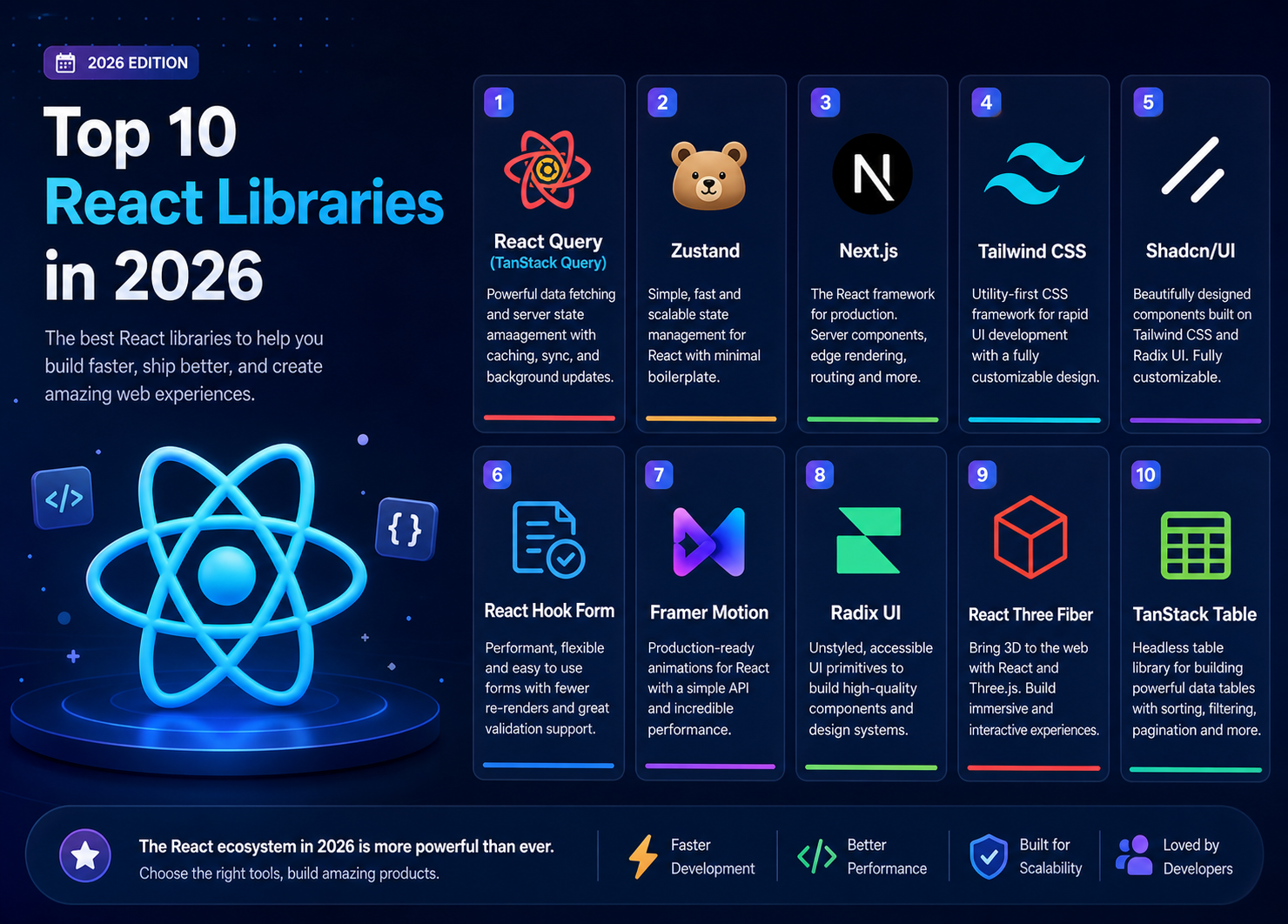
React continues to dominate the frontend ecosystem in 2026, but the real power of React comes from its rich library ecosystem. Whether you’re building a startup MVP, an enterprise dashboard, or a high-performance web app, choosing the right libraries can dramatically improve your workflow and product quality.
Here are the 10 best React libraries in 2026 that developers are relying on.
1. React Query (TanStack Query)
React Query remains a must-have for managing server state. It simplifies data fetching, caching, synchronization, and background updates. With automatic retries and stale data handling, it eliminates much of the boilerplate around API calls.
2. Zustand
Zustand has become one of the most popular state management solutions thanks to its simplicity and minimal boilerplate. Unlike Redux, it’s lightweight and easy to scale, making it ideal for both small and large applications.
3. Next.js
Next.js is no longer just a framework—it’s the standard for building React apps. With features like server components, edge rendering, and built-in routing, it provides everything needed for modern web development.
4. Tailwind CSS
Although technically a CSS framework, Tailwind integrates seamlessly with React. Its utility-first approach allows developers to build responsive and clean UIs without writing custom CSS.
5. Shadcn/UI
Shadcn/UI has exploded in popularity due to its elegant, customizable component system built on top of Tailwind and Radix UI. It gives developers full control without sacrificing design quality.
6. React Hook Form
Forms are often painful to manage, but React Hook Form makes them fast and efficient. It minimizes re-renders and integrates well with validation libraries like Zod and Yup.
7. Framer Motion
For animations, Framer Motion is still the gold standard. It allows developers to create smooth, complex animations with minimal code while maintaining performance.
8. Radix UI
Radix provides accessible, unstyled UI primitives that developers can fully customize. It’s perfect for building design systems while ensuring accessibility compliance.
9. React Three Fiber
For 3D experiences in the browser, React Three Fiber brings WebGL into React. It’s widely used for interactive websites, product visualization, and immersive storytelling.
10. TanStack Table
TanStack Table is a powerful headless table library that allows full customization. It’s ideal for dashboards and data-heavy applications requiring sorting, filtering, and pagination.
Conclusion
The React ecosystem in 2026 is more mature than ever. The trend is clear: developers prefer lightweight, flexible, and composable tools over heavy, opinionated frameworks. By combining these libraries, you can build fast, scalable, and modern web applications with ease.