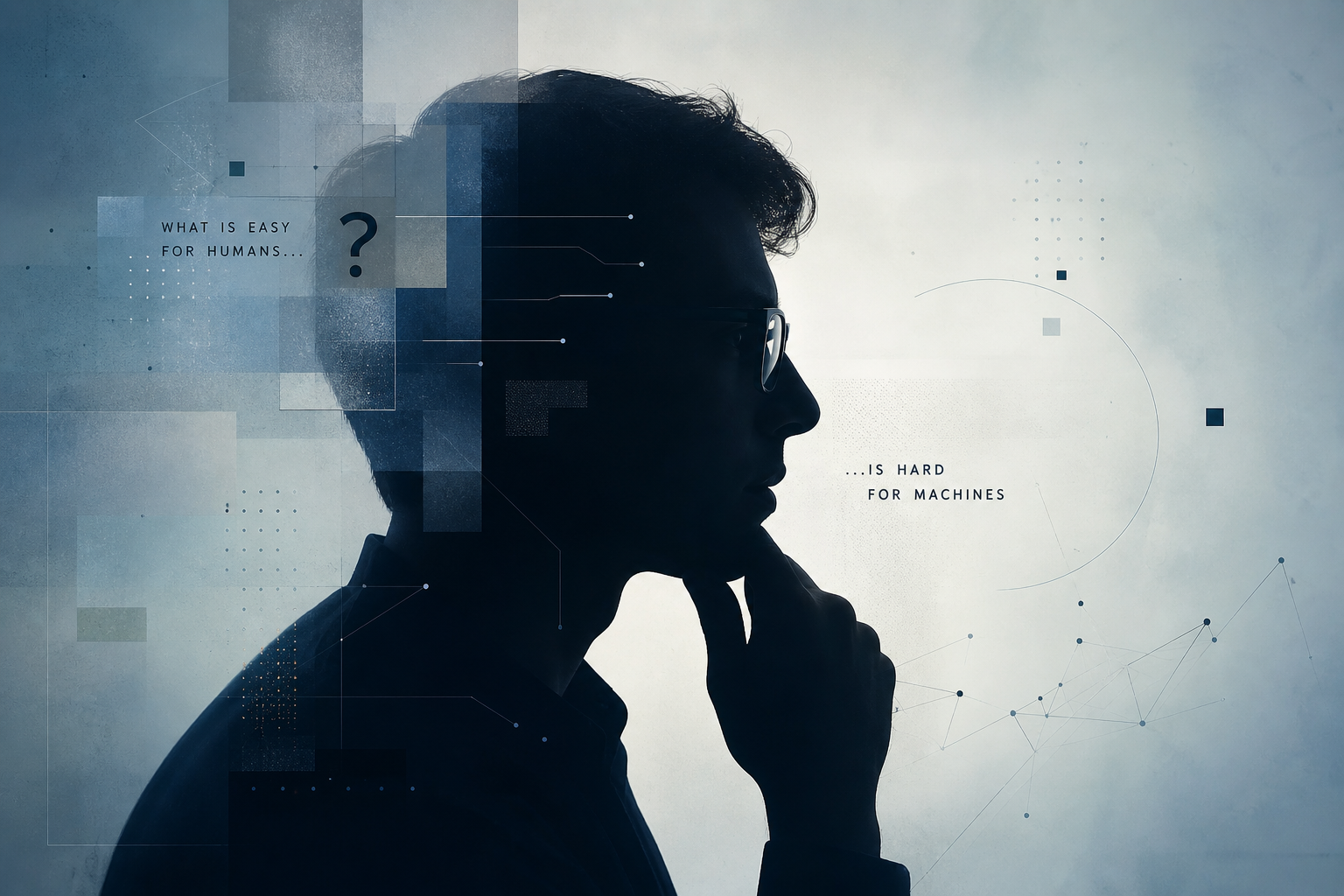
Moravec’s Paradox is a fascinating observation in the field of artificial intelligence and robotics, named after the scientist Hans Moravec. It highlights a counterintuitive reality: tasks that humans find difficult—such as complex calculations or logical reasoning—are often easy for computers, while tasks that humans perform effortlessly—like perception, movement, and social interaction—are extremely challenging for machines.
At first glance, this seems paradoxical. Computers can outperform humans in areas like playing chess, solving equations, or analyzing vast datasets. These activities require abstract reasoning and structured logic, which align well with how computers process information. Algorithms can follow precise rules and execute calculations at incredible speed, making them highly effective in domains that demand formal thinking.
However, when it comes to seemingly simple human abilities—recognizing faces, walking across uneven terrain, or understanding tone and context in conversation—machines struggle. These tasks rely on millions of years of evolutionary refinement in the human brain. Skills like vision, motor coordination, and intuitive judgment are deeply embedded in our biology and operate largely unconsciously. Because we perform them without effort, we tend to underestimate their complexity.
Moravec argued that what is “hard” for humans is often recent in evolutionary terms, such as mathematics or formal logic, and therefore not deeply ingrained in our neural systems. In contrast, sensorimotor skills have been shaped over a much longer evolutionary timeline, making them highly optimized but also incredibly complex to replicate artificially. As a result, programming a robot to navigate a cluttered room or grasp an object with human-like dexterity remains a significant challenge.
This paradox has important implications for the development of artificial intelligence. It suggests that progress in AI is not linear and that replicating human intelligence requires more than improving computational power. Researchers must address the subtleties of perception, learning, and interaction—areas where humans excel but machines lag behind.
In recent years, advances in machine learning and neural networks have begun to narrow this gap. Technologies like computer vision and natural language processing have improved significantly, allowing machines to recognize images, understand speech, and even generate human-like text. Nevertheless, these systems still lack the general adaptability and intuitive understanding that characterize human intelligence.
Moravec’s Paradox reminds us that intelligence is not a single, uniform ability but a collection of diverse skills, many of which are deeply rooted in our evolutionary history. It challenges assumptions about what it means to be “smart” and encourages a more nuanced view of both human and artificial intelligence. As AI continues to evolve, understanding this paradox remains essential for guiding research and managing expectations about what machines can—and cannot—do.