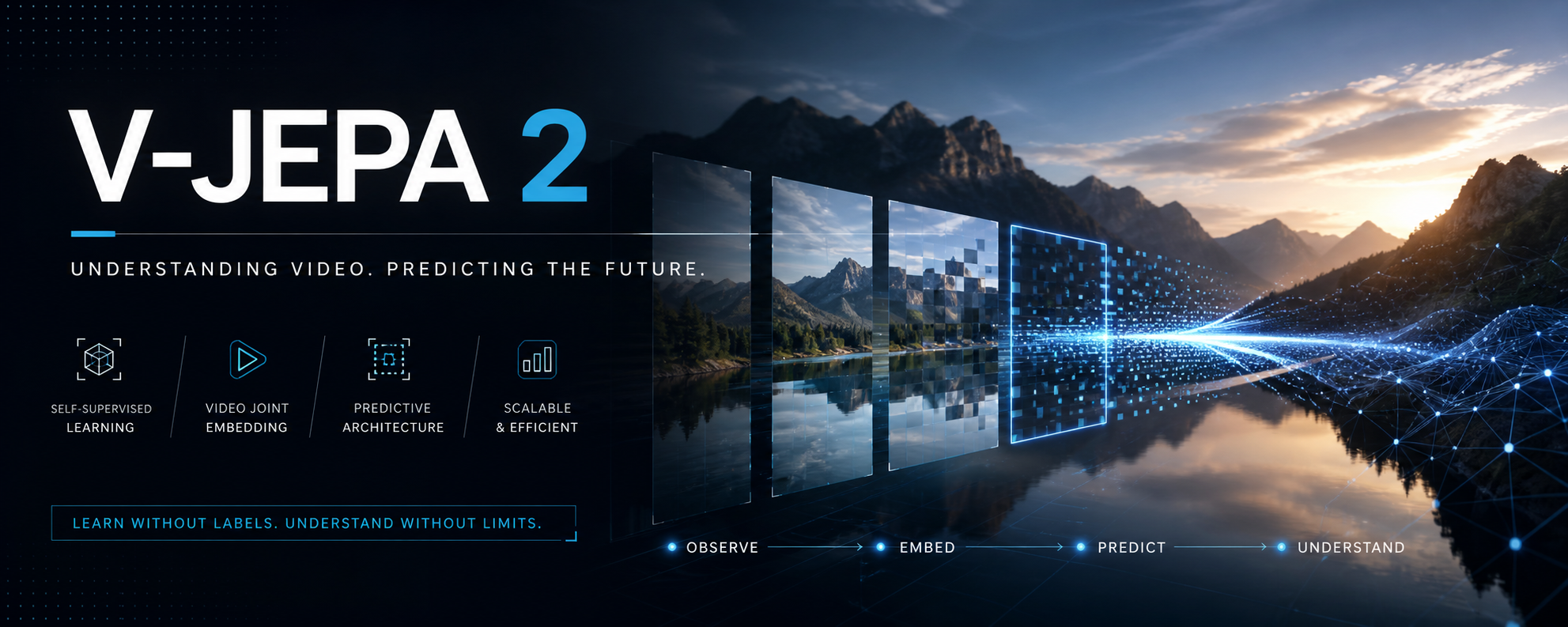
In recent years, self-supervised learning has emerged as one of the most promising paradigms in artificial intelligence, enabling models to learn meaningful representations from vast amounts of unlabeled data. Among the most exciting developments in this field is V-JEPA 2 (Video Joint Embedding Predictive Architecture 2), a next-generation model that pushes the boundaries of how machines understand the visual world.
V-JEPA 2 builds upon the foundation laid by its predecessor, introducing a refined architecture designed to predict and understand complex visual dynamics in video data. Unlike traditional supervised models that rely heavily on labeled datasets, V-JEPA 2 learns by predicting missing or masked portions of video sequences. This predictive capability allows the model to develop a deep understanding of spatial and temporal relationships without explicit human annotation.
At its core, V-JEPA 2 operates by encoding video inputs into a latent representation space where patterns and structures can be efficiently modeled. The model then learns to anticipate future states or reconstruct hidden segments based on contextual cues. This approach mimics, in some ways, how humans perceive and interpret motion and continuity in the real world. By focusing on prediction rather than classification, V-JEPA 2 captures richer and more generalizable features.
One of the key innovations of V-JEPA 2 lies in its scalability and efficiency. The architecture is designed to handle large-scale video datasets, making it particularly well-suited for applications in autonomous driving, robotics, and video analytics. Its ability to learn from raw, unlabeled video significantly reduces the cost and effort associated with data annotation, opening the door to broader and more diverse training sources.
Moreover, V-JEPA 2 demonstrates impressive robustness across different domains. Whether applied to natural scenes, human activities, or synthetic environments, the model maintains strong performance in understanding motion, predicting outcomes, and extracting meaningful representations. This adaptability suggests that V-JEPA 2 could serve as a foundational model for a wide range of downstream tasks, including action recognition, scene understanding, and even multimodal reasoning.
Another important aspect of V-JEPA 2 is its alignment with the broader trend toward general-purpose AI systems. Rather than being narrowly optimized for a specific task, the model is designed to learn transferable knowledge that can be fine-tuned or adapted for various applications. This flexibility is crucial as the field moves toward more integrated and versatile AI solutions.
Despite its advantages, challenges remain. Training such large models requires significant computational resources, and ensuring fairness and bias mitigation in learned representations continues to be an important area of research. Nonetheless, V-JEPA 2 represents a substantial step forward in the quest to build machines that can perceive and understand the world more like humans do.
In conclusion, V-JEPA 2 exemplifies the evolution of self-supervised learning in computer vision. By leveraging predictive modeling and large-scale video data, it offers a powerful and efficient approach to visual understanding. As research continues, models like V-JEPA 2 are likely to play a central role in shaping the future of AI, bringing us closer to systems that can learn autonomously and adapt intelligently to complex environments.